
Why Some Products on Shopee Are Cheaper Than Direct Import Prices
Many first-time importers assume direct sourcing from China is always cheaper. Learn how order volume, shipping costs, economies of scale, and product quality affect pricing.
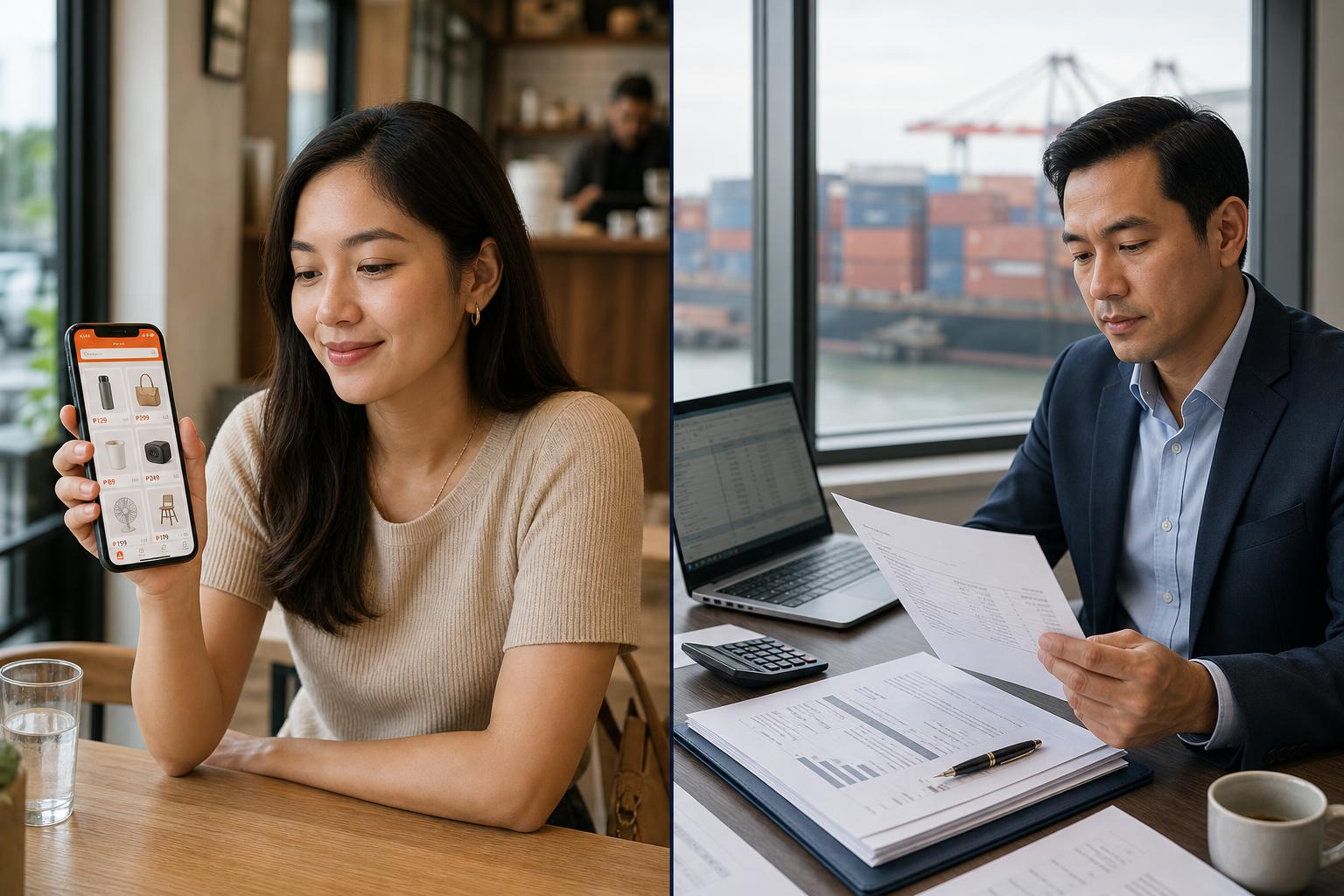
Many first-time importers in the Philippines are surprised when they compare direct sourcing prices from China with products already being sold on Shopee, Lazada, or by local wholesalers.
One of the most common questions we hear from Filipino business owners and aspiring importers is:
Why is Shopee cheaper than importing directly from China? If I can buy the same product locally at a lower price, why should I even bother sourcing from a factory?
It is a fair question, and the answer is not always obvious. The truth is that direct sourcing from China is not always cheaper - especially for very small orders. To understand why, it helps to look at how large, experienced importers buy, and how economies of scale affect pricing.
Understanding How Large Importers Buy
Established importers in the Philippines often purchase products in large volumes. Some import full container loads, while others place regular bulk orders directly with manufacturers they have worked with for years.
Because they buy in higher quantities, they are able to negotiate significantly better terms:
- Lower factory pricing per unit - factories are willing to reduce margins to secure large, repeat orders.
- Better shipping rates - freight forwarders offer lower per-unit costs for full container loads (FCL) compared to small parcel or less-than-container-load (LCL) shipments.
- Lower landed cost per unit - customs processing, warehousing, and inland transport are spread across thousands of items rather than dozens.
- More favorable payment terms - long-term relationships often lead to deposit flexibility and credit arrangements.
This is what economists call economies of scale. When you buy one item, you pay the standard price. When you buy ten thousand, the cost to produce, pack, and ship each individual piece goes down. The factory saves on setup time. The shipper fills a container efficiently. The importer pays less per unit at every stage.
For a new importer placing a first-time trial order of fifty or one hundred pieces, these volume advantages simply do not apply yet.
Why Small Orders Often Cost More
When a business is just starting, order quantities are usually smaller. Factories have minimum order quantities (MOQs) for a reason - setting up machinery, sourcing raw materials, and managing production all have fixed costs. A small order absorbs those fixed costs over fewer units, which raises the price per piece.
Smaller orders also mean:
- Higher unit costs - factories charge more per piece for low-volume orders.
- Minimum order quantity (MOQ) limitations - some suppliers may not accept very small orders at all.
- Higher shipping cost per item - air freight or small LCL shipments carry a premium compared to full container rates.
- Less room for price negotiation - suppliers prioritize buyers who can commit to volume.
This is completely normal and applies across nearly every manufacturing industry. It is not a sign that sourcing is impossible - it simply means that pricing improves as your order volume and experience grow.
Example: Why a Local Seller May Appear Cheaper
Let us look at a simplified but realistic example to see how this plays out in practice.
Small Importer
First-time trial order
- Order quantity
- 100 pcs
- Factory price
- ₱180 / pc
- Product cost
- ₱18,000
- Shipping, customs & other
- ₱12,000
- Total landed cost
- ₱30,000
- Cost per piece
- ₱300
Large Importer
Established bulk buyer
- Order quantity
- 10,000 pcs
- Factory price
- ₱120 / pc
- Product cost
- ₱1,200,000
- Shipping, customs & other
- ₱150,000
- Total landed cost
- ₱1,350,000
- Cost per piece
- ₱135
In this example, the large importer pays ₱135 per piece, while the small importer pays ₱300. The difference is not because the small importer is doing something wrong - it is simply the effect of volume, shipping efficiency, and established supplier relationships.
Key Takeaway: Large importers negotiate lower factory prices and spread logistics costs across more units. Their landed cost per piece is significantly lower because of economies of scale - not because direct sourcing is inherently cheap at any volume.
Does This Mean You Need a Huge Capital to Start Importing?
No. One of the biggest misconceptions about importing is that you need millions of pesos to get started. Many successful businesses in the Philippines began with smaller quantities and grew over time.
Consider this real-world scenario: A client approached Quorium wanting to source pillows from China. After researching factory prices, shipping rates, and import duties, he discovered that similar pillows were already being sold in the Philippines at nearly the same price as his projected landed cost.
At first, this was discouraging. But instead of giving up, he asked a better question: How can I offer something different?
Working with the factory, he chose to:
- Use higher-quality foam and fabric instead of standard materials
- Customize the pillow size and firmness for better comfort
- Create custom packaging that reflected a premium brand identity
- Add private-label branding so his products stood out in the marketplace
The result? He was not competing on the lowest price anymore. He was offering a better product with stronger branding - and his customers were willing to pay more for it.
This is the real opportunity in direct sourcing: it is not always about finding the cheapest version of the same product. It is about using factory access to build something better, something unique, and something that your competitors cannot easily copy.
Not Every Customer Wants the Cheapest Product
There is another important point that many new importers overlook: not every buyer is looking for the lowest price.
Walk through any major mall in Metro Manila or browse premium listings online, and you will see consumers regularly choosing products that cost more because they trust the quality, the brand, or the overall experience.
When comparing products, it is important to remember that two items may look similar but can have significant differences in:
- Materials used - higher-grade materials last longer and perform better.
- Manufacturing standards - stricter quality control means fewer defects.
- Durability and product lifespan - a cheaper item that breaks quickly costs more over time.
- Packaging quality - first impressions matter, especially for retail and gifting.
- Certifications and compliance - safety standards, chemical testing, and import documentation.
- Branding and perceived value - a strong brand commands higher prices and customer loyalty.
Many consumers are willing to pay more for a product they trust. They want reliability, better customer experience, and the confidence that what they are buying will meet their expectations. This is why the cheapest option is not always the best option - for the end customer, and for your business.
A product that costs slightly more to source but sells at a higher margin, generates repeat customers, and builds brand reputation can be far more profitable than the lowest-priced alternative.
When Direct Sourcing Makes Sense
Direct sourcing from China is often most valuable when businesses need more than just a low price. It makes the greatest impact when you are looking for:
- Consistent product quality - working directly with the factory allows you to set and enforce your own standards.
- Customized products - you can adjust specifications, colors, sizes, and features to match your market.
- Private labeling and branding - build your own brand instead of reselling generic goods.
- Better supplier control - direct communication reduces misunderstandings and improves accountability.
- Long-term supply chain stability - established factory relationships protect you from stock shortages and price spikes.
- Access to manufacturers - some factories do not sell through local marketplaces at all.
For businesses that plan to grow, direct sourcing offers advantages that extend far beyond the initial unit price.
How Quorium Helps
At Quorium International Trade, our goal is not simply to find the cheapest supplier. We believe that successful sourcing is about finding the right supplier for your specific business goals.
We help Filipino importers and business owners identify suppliers that match their requirements for quality, pricing, production capability, and long-term reliability.
Whether you are sourcing consumer products, construction materials, solar equipment, furniture, electronics, medical supplies, or industrial goods, our focus is on helping you find the right balance between cost, quality, customization, and growth potential.
From supplier shortlisting and factory verification to quality control and logistics coordination, Quorium provides end-to-end China-Philippines sourcing support.
Conclusion
Direct sourcing from China is not always cheaper for very small orders. Large importers often benefit from years of supplier relationships, larger purchase volumes, and economies of scale that new importers cannot match immediately.
However, the real value of direct sourcing goes far beyond price. It is about finding the right balance between cost, quality, reliability, branding opportunities, and long-term business growth.
For businesses that are willing to invest in better products, stronger branding, and reliable supplier partnerships, sourcing directly from China can be one of the most valuable strategic decisions you make.
The question is not whether Shopee is cheaper. The question is whether you want to sell the same product as everyone else - or build something better.
Ready to Start Sourcing Smarter from China?
Quorium International Trade provides end-to-end sourcing support for Philippine importers - from supplier verification and factory coordination to quality control, custom branding, and shipping logistics. Let us help you build a product line that stands out.
Back to Quorium International Trade home.